The 6 Types of Supply Chains: Which Is the Ideal Model for Your Company?
TLDR
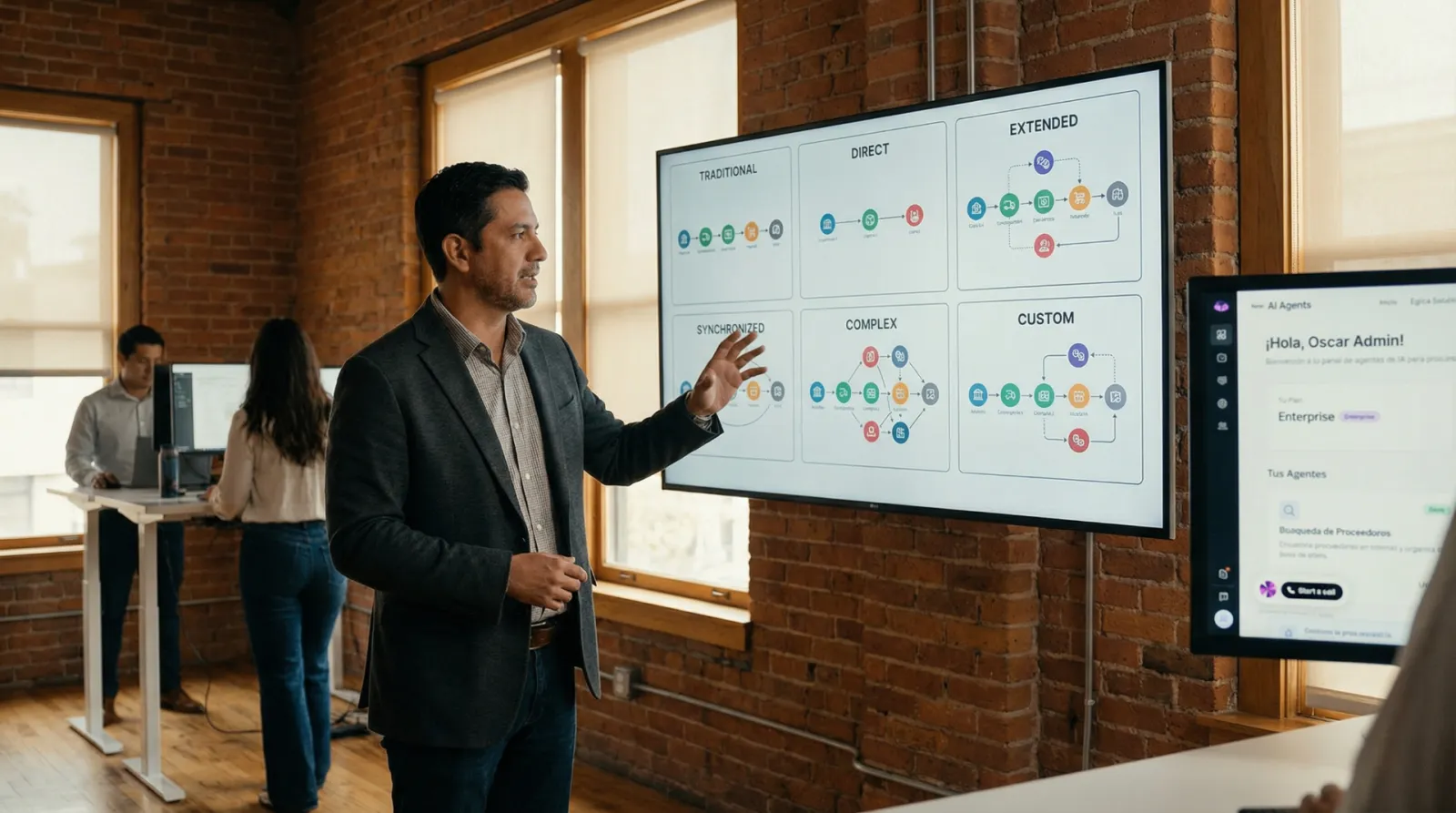
There are 6 main supply chain models: traditional, direct, extended, synchronized (JIT), complex, and customized (MTO). The choice depends on demand predictability and product lifecycle. Modern enterprises in LATAM combine multiple models with AI to create optimized hybrid chains.
Why choosing the right supply chain model matters
In strategic operations design, there is no "one size fits all." Implementing the wrong model can result in millions of dollars in obsolete inventory or, worse, in the inability to meet customer demand. Understanding the different types of supply chains is the first step to building an operational network that truly drives your business profitability.
According to a Deloitte study, 65% of companies that align their supply chain model with their global competitive strategy outperform their competitors in operating profit margin. In this article, we will analyze the 6 main models, their advantages, disadvantages, and how technology is blurring the lines between them in the Latin American market.
1. Traditional Supply Chain (Decentralized)
This is the most basic model and, unfortunately, the most error-prone. In a traditional chain, each link (supplier, manufacturer, distributor) acts autonomously, making decisions based solely on its own interests and projections, without sharing information with the rest of the network.
Ventajas
Easy to implement for small businesses. No investment in technology integration required.
Desventajas
Highly inefficient. Generates the "bullwhip effect" (excess inventory). Poor response capacity to disruptions.
Ejemplo
A small local furniture manufacturer that buys wood from a sawmill without long-term sales forecasting and sells to independent retailers.
2. Direct Supply Chain (Agile)
Of all types of supply chains, this is the simplest and fastest. It eliminates unnecessary intermediaries (such as wholesalers or regional distributors) and connects the manufacturer directly to the end customer or, at most, through a single raw material supplier.
Ventajas
Extremely fast time-to-market. Higher profit margins by eliminating intermediaries. Total control over customer experience.
Desventajas
Difficulty scaling geographically. The company assumes all logistics costs and risks.
Ejemplo
Digital-native brands (D2C) that manufacture their own clothing and sell exclusively through their website, shipping directly from factory to consumer.
3. Extended Supply Chain (Collaborative)
This model recognizes that competition is not between companies, but between chains. It involves deep collaboration not only with direct suppliers (Tier 1), but with suppliers' suppliers (Tier 2 and 3) and customers' customers.
Ventajas
Total visibility. Risk reduction. Ability to innovate jointly with suppliers.
Desventajas
Requires high digital maturity, extreme trust between parties, and shared technology platforms.
Ejemplo
Major supermarket chains (like Walmart or Cencosud) that share real-time POS sales data with manufacturers so they automatically adjust production.
Ready to digitize your procurement?
Discover how Egixia automates the full Procure-to-Pay cycle with AI, SAP/Oracle integration, and local LATAM support.
4. Synchronized Supply Chain (Just-in-Time)
Famous for Toyota's production model, the synchronized chain operates with minimal or zero inventory. Materials arrive exactly when needed for production, and finished products are shipped immediately.
Ventajas
Near-zero storage costs. High capital efficiency. Lower product obsolescence risk.
Desventajas
Extremely vulnerable to disruptions (a few hours' delay from a supplier can halt an entire factory).
Ejemplo
The automotive industry in Mexico, where auto parts suppliers deliver components to assembly plants within 15-minute time windows.
5. Complex Supply Chain (Global)
This is the dominant model in multinational corporations. It involves multiple product lines, thousands of suppliers across different continents, multimodal logistics networks (maritime, air, ground), and compliance with diverse customs regulations.
Ventajas
Access to the best costs and talent globally. Geographic risk diversification.
Desventajas
Extremely high management complexity. Vulnerability to geopolitical events, pandemics, or global logistics crises.
Ejemplo
Technology companies like Apple, which design in the US, buy chips in Taiwan, assemble in China/India, and distribute worldwide.
6. Customized Supply Chain (Make-to-Order)
Also known as Make-to-Order (MTO). Instead of manufacturing to stock based on forecasts, production only begins when the customer places a firm order. Ideal for high-value or highly configurable products.
Ventajas
Zero finished product inventory. High customer satisfaction through personalization.
Desventajas
Longer delivery times for the customer. Raw material suppliers must be extremely agile.
Ejemplo
Heavy industrial machinery manufacturers or companies like Dell (in its early days), where the customer configures their server before assembly.
Comparison Table: Which Model to Choose?
| Product Type | Demand | Recommended Model | Strategic Focus |
|---|---|---|---|
| Basic goods (FMCG) | Predictable / Stable | Extended / Efficient | Cost reduction and economies of scale |
| Fashion / Consumer tech | Unpredictable / Volatile | Direct / Agile | Speed of response and flexibility |
| Automotive / Manufacturing | Stable (with variations) | Synchronized (JIT) | Zero inventory and perfect synchronization |
| Machinery / Luxury | Made to order | Customized (MTO) | Quality and specification compliance |
How AI Adapts Your Model to LATAM Reality
Regardless of the model you choose, Latin America's reality (long distances, variable infrastructure, complex regulations) demands that your supply chain be backed by robust technology. Modern companies no longer choose a single model — they create hybrid models through digitalization.
The EGIXIA Procure-to-Pay platform, powered by Artificial Intelligence, allows you to manage any type of supply chain from a single control point: if you operate an extended chain, the Supplier Portal ensures real-time visibility; if you operate a synchronized chain, AI Agents monitor supplier risks to prevent disruptions; if you operate a complex chain, ERP integrations (SAP, Oracle) unify subsidiary data across countries.
The right model requires the right suppliers. And the right suppliers require the right technology to manage them.
Frequently Asked Questions about Supply Chain Types
Need to optimize your supply chain model?
Request a demo of Egixia and discover how our AI-powered platform can manage any type of supply chain.
Request Demo