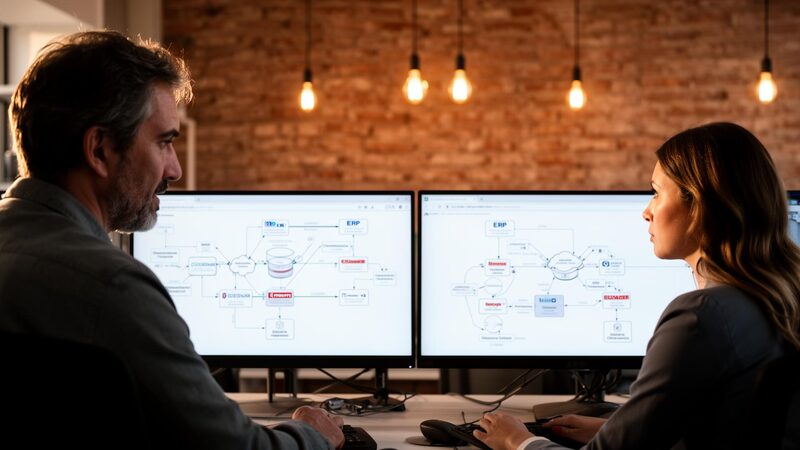
Integrating Procurement with SAP in Colombia: Step-by-Step Guide 2026
TLDR
Integrating procurement with SAP in Colombia in 2026 no longer requires 18 months. With native connectors, clean master data and a design that contemplates DIAN (Resolution 000165/2023, amended by 000202/2025) and SAP's new API Policy v4/2026, a standard integration runs in 4 to 8 weeks. The difference between success and failure lies in master data cleanup, license models that don't penalize adoption, and an AI agent layer (Supplier Risk Agent, Document Verification, Assisted Negotiation) that turns visibility into decisions.
1. Why SAP-procurement integration is critical for large enterprises in Colombia in 2026
47% of business leaders cite integration complexity as the main barrier to obtaining ROI from their tech tools, according to 2026 data. For Colombian companies running SAP, this is not an abstract statistic: it's the bottleneck that keeps the CPO receiving spend reports two weeks late and turns DIAN reconciliation into a quarterly nightmare.
The good news: in 2026, integrating procurement software with SAP no longer requires 18 months or a seven-figure consulting project. The bad: doing it wrong is still extremely costly and more frequent than it should be.
In Colombia, the context adds specific complexity layers:
- Mandatory DIAN compliance. Resolution 000165 of 2023 (amended by 000202 of 2025) requires every VAT-responsible legal entity to issue and receive electronic invoices with DIAN pre-validation. Any procurement platform managing accounts payable must connect technically to the e-invoicing flow.
- SAP as the backbone. According to SAP's Country Manager in Colombia, "2026 is the decisive year for organizations to move from experimentation to real value generation."
- SAP's new API Policy. API Policy v4/2026 standardizes the use of programming interfaces across all SAP environments and impacts platforms that historically connected via RFC calls, BAPIs or unpublished routes.
2. The 4 integration models available (and which to choose based on digital maturity)
There is no single way to integrate procurement with SAP. The choice depends on your SAP version, internal technical capacity and the functional scope you want to cover.
| Model | How it works | Best for | Complexity |
|---|---|---|---|
| Native SAP integration (Ariba Network / SAP MM) | Procurement lives inside the SAP ecosystem; direct S/4HANA APIs | 100% SAP S/4HANA companies with strong internal BASIS team | High |
| Middleware / iPaaS (MuleSoft, SAP Integration Suite, Boomi) | Intermediate platform orchestrating data exchange | SAP ECC or S/4HANA with third-party procurement | Medium-High |
| Pre-built native connectors | Procurement vendor offers certified SAP ECC/S4HANA connectors ready to configure | Companies seeking fast time-to-value without custom dev | Medium |
| Bidirectional REST API | Point-to-point API integration aligned with v4/2026 policy | Modern architecture and agile dev team | Medium |
Practical recommendation for Colombian companies in 2026: If you run SAP ECC and want to digitize procurement without migrating to S/4HANA immediately, the combination of pre-built native connectors with lightweight middleware is the lowest-risk, fastest path. If you're already on S/4HANA, published APIs are the correct route — verified against the v4/2026 policy.
3. Step by step: how to execute SAP-procurement integration
Step 1 — Diagnosis and process mapping. Map precisely which processes will be integrated and in which direction data flows: SAP version, active modules, priority P2P flows and master data state.
Step 2 — Architecture and middleware choice. Define the source of truth for each object, sync frequency (event-driven, batch or hybrid), certified middleware and exception handling.
"The key lies in orchestrating solid cloud infrastructure and reliable data; only then does technology move from an isolated project to becoming the foundation of sustainable profitability."
- Step 3 — Master data synchronization. This is where most projects fail. Duplicate suppliers with the same tax ID, materials without DIAN code, outdated cost centers. Cleanup is the difference between an integration that works day one and one that generates manual exceptions for months.
- Step 4 — P2P flow configuration. Requisition in procurement → Purchase Requisition in SAP MM → approval → PO in SAP and supplier notification → goods receipt (MIGO) → DIAN-validated electronic invoice → 3-way match → payment approval → FI document in SAP.
- Step 5 — DIAN compliance and electronic invoicing. XML UBL 2.1 generation with digital signature, CUFE assignment, DIAN pre-validation and supplier Responsibility 52 verification. Best practice: contract a DIAN-authorized Technology Provider (more than 80 enabled) offering SAP API integration.
- Step 6 — Testing, go-live and adoption. Three test layers: technical integration, business and UAT. Phased go-live starting with one spend category or pilot supplier group.
4. The most common mistakes in SAP-procurement integrations (and how to avoid them)
- Mistake 1 — Starting with dirty data. The technical setup is flawless, but master data has duplicate suppliers, unclassified materials and obsolete cost centers. Fix: master data cleanup as a formal prerequisite.
- Mistake 2 — Underestimating the API Policy v4/2026 impact. Many 3-5 year old integrations use RFC calls or BAPIs that no longer comply. Fix: technical audit of all existing integrations before starting.
- Mistake 3 — Ignoring electronic invoicing until the end. AP flow is configured, but nobody thought about DIAN validation. Fix: include DIAN flow in the scope from initial design.
- Mistake 4 — Not training the supplier base. Integration works, but suppliers don't know how to submit electronic invoices. Fix: digital supplier onboarding program as part of the implementation plan.
- Mistake 5 — Per-user licensing that hampers adoption. IT limits access to control costs and ends up with less spend visibility. Fix: per-module licensing with unlimited user access.
5. SAP Ariba vs alternatives with native SAP integration in Colombia
Not all procurement platforms integrate equally with SAP, and the cost of that difference is felt in implementation time, total cost and operational flexibility.
| Criterion | SAP Ariba | Global alternatives (Coupa, Ivalua) | Egixia |
|---|---|---|---|
| Native SAP integration | Yes, via Ariba Network | Multi-ERP, varies by version | Native SAP ECC and S/4HANA |
| Colombia DIAN compliance | Not native (needs middleware) | Not native | DIAN integration included |
| Implementation time | 12-24 months | 6-12 months | 4-8 weeks |
| Licensing | Per user | Per user | Per module |
| Spanish support Colombia | Limited / via partners | Minimal | Direct |
| SAP API Policy v4/2026 | Compatible | Varies | Compatible |
| Relative cost | $$$ | $$$ | $$ |
For Colombian companies, the differentiator is not just technical SAP integration — it's the combination with local DIAN compliance, Spanish support and a licensing model that does not penalize broad adoption. See the Egixia vs SAP Ariba detailed comparison.
6. The role of AI agents in procurement-SAP integration
Integrating systems is necessary but not sufficient. Organizations generating real competitive advantage in 2026 add an AI layer on top of the integration — not to replace SAP, but to power the decisions SAP cannot make alone.
According to Deloitte's 2025 Global CPO Survey, "Digital Masters" deploy AI and ML at 3x the rate of competitors, capturing 15-30% efficiency improvements through AI automation.
The Egixia AI agents act directly on the data flowing from the SAP integration, always as a copilot for your team, never replacing it:
- Supplier Risk Agent. Real-time monitoring of suppliers registered in SAP — financial, legal and reputational signals — with proactive alerts before a critical supplier fails.
- Document Verification. Automated verification of received electronic invoices, detecting inconsistencies before reaching the SAP approval flow.
- Assisted Negotiation. Uses historical purchase data from SAP to prepare negotiation strategies grounded in real benchmarks.
7. Frequently Asked Questions
8. Conclusion: Integration is not an IT project, it's a strategic decision
In 2026, the Colombian companies leading procurement are not the ones with the biggest ERP or technology budget. They are the ones that connected their ecosystem so the CPO has real spend visibility, the CIO has technical peace of mind and the procurement team can operate with agility within regulatory compliance.
Integrating procurement with SAP correctly — with the right architecture, clean master data, integrated DIAN compliance and an AI layer that powers decisions — is the foundation. With the right tools and approach, it's a 4-to-8 week project with demonstrable ROI in the first quarter.
See also the best procurement software for companies in Colombia and our native SAP integration.
Ready to take your procurement to the next level?
Request a demo of Egixia and discover how our platform can transform your supply chain.
Request Demo