Strategic guide · Assessment framework · 2026

    Procurement Digital Maturity Benchmark for Latin America

    A five-dimension, five-level framework to diagnose where your procurement function stands today, see what separates it from the next level and sequence the digitalization roadmap without disrupting operations.

    By Oscar Gamboa, CEO of EGIXIA · Updated August 11, 2026

    Full guide on this page · no form, no download

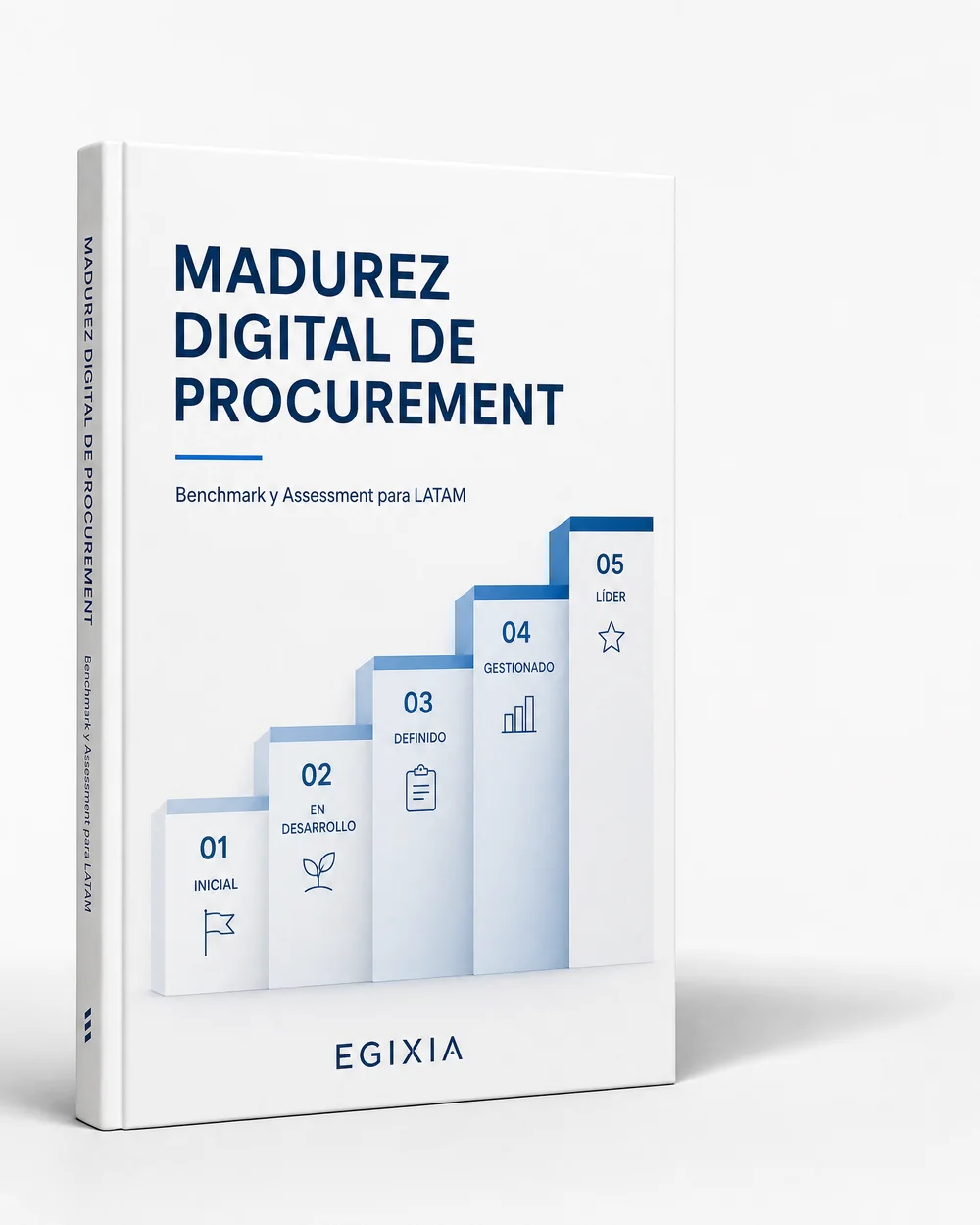
    Cover of the Egixia Procurement Digital Maturity Benchmark
    Companion resource

    This guide explains the framework. The Excel Assessment applies it and calculates your score.

    Here you will find the five dimensions, the five levels and the signals that tell one from another. The Procurement Digital Maturity Assessment turns that same framework into a weighted questionnaire and returns a level per dimension, with the specific gap to the next level. Both resources use the same dimension and level names, so what you read here you will recognize exactly as it appears in the Excel workbook. Read them in that order: criteria first, measurement second.

    Open the Digital Maturity Assessment (Excel)

    The Excel workbook is in Spanish.

    Executive summary

    Digitalizing procurement and sourcing has become a critical lever for competitiveness and operational resilience in large Latin American organizations. This document presents a methodological framework structured around five key dimensions and five progressive levels of digital maturity, designed so that chief procurement officers (CPOs), finance leaders and technology executives can diagnose their current situation, identify operational gaps and design technology roadmaps without taking on disruption risk.

    Drawing on international standards and regional dynamics, the guide offers actionable guidelines, an operational checklist, tracking metrics and a ninety-day action plan to accelerate corporate spend efficiency.

    Who this guide is for

    This resource is aimed at professionals and decision-makers in large Latin American enterprises who lead or directly influence sourcing strategy.

    Chief Procurement Officers (CPOs) and procurement managers

    Looking to structure an objective diagnosis of their technology capabilities, justify investment to the board and scale the strategic impact of the function.

    Chief Financial Officers (CFOs) and controllers

    Focused on maximizing corporate spend visibility, reducing tied-up working capital and ensuring regulatory compliance across the supply chain.

    Technology and digital transformation leaders (CIOs / CTOs)

    Who need to align procurement tools with the existing enterprise architecture, integrating secure and scalable data flows.

    Context: how procurement is evolving in Latin America (2026)

    The macroeconomic and operating environment in Latin America requires procurement departments to move from a strictly transactional role — focused on immediate unit-price reduction and purchase order management — toward strategic value management and risk mitigation. Recent disruptions across global and regional supply chains exposed the vulnerability of manual processes and the lack of real-time visibility over the supplier base.

    Digital maturity in procurement is not measured by the adoption of isolated software alone, but by the degree to which technology, data and automated processes are integrated to optimize decision-making and financial risk management.
    — Corporate sourcing trends analysis

    Large companies in the region face specific challenges: regulatory fragmentation across countries, multiple legacy ERP systems, and the need to reconcile economies of scale with local operational agility. Adding analytics and assisted automation makes it possible to overcome those barriers and turn scattered procurement data into actionable intelligence for senior management.

    The five assessment dimensions

    To assess procurement digitalization precisely, the model is a matrix: five structural dimensions —Strategy, Process, Data, Technology and Talent—, each rated across five progressive maturity levels. Maturity shows up in behaviors, not in the inventory of installed tools. And an organization is rarely at the same level in all five — that is exactly where the value of the diagnosis lies.

    D1

    Strategy

    Alignment of procurement with corporate objectives, a funded digital and AI transformation plan, active executive sponsorship, spend governance with compliance and sustainability policies, KPIs beyond cost savings, and supplier management as a strategic role.

    D2

    Process

    Standardization, automation and integration of the Source-to-Pay (S2P) cycle, from requisition through payment and contract management: approval flows with clear delegation rules, structured tendering (RFx) methodology, supplier onboarding, qualification and periodic performance evaluation, and contract renewal alerts.

    D3

    Data

    A single source of truth for spend and contracts, granular spend categorization (spend cube), real-time dashboards and predictive indicators, and a validated, monitored supplier master record: current legal and tax documentation, segmentation by criticality, and financial and reputational third-party risk alerts.

    D4

    Technology

    Integrated ERP or e-procurement suite, automation of transactional tasks, AI agents for contract and invoice extraction and analysis, collaborative supplier portals, and secure, scalable cloud infrastructure.

    D5

    Talent

    Skills in strategic negotiation and data analytics, continuous training on digital tools and AI, time devoted to high-value activities, clear roles and career paths, change management and a culture of technology adoption.

    Supplier and third-party risk management does not appear as a sixth dimension, and that is not an oversight: evaluation, qualification and onboarding are part of the Source-to-Pay process, so they are diagnosed under Process; document validation and supplier master record monitoring are a data quality problem, so they are diagnosed under Data. Splitting them out duplicates the diagnosis and spreads the same gap across two boxes. To go deeper into third-party risk classification —criteria, weighting and a prioritization matrix— use the dedicated resource: Supplier Risk Matrix (Excel template)

    The five digital maturity levels

    The levels are cumulative: each one assumes the previous is consolidated. Skipping a level is the most frequent cause of digitalization programs that stall halfway through. Nor is the goal to compare yourself against global front-runners: it is to identify the next level that is genuinely reachable for a specific Latin American operation.

    LevelNameGeneral description
    Level 1Initial / Ad-hocReactive, decentralized and highly manual processes based on spreadsheets and email; fragmented spend visibility and critical dependence on individual knowledge.
    Level 2DevelopingPartial, now repeatable standardization through basic ERP modules; still tactical buying, early electronic catalogs and emerging compliance controls.
    Level 3DefinedS2P processes formalized, documented and integrated into a unified platform; established governance, centralized spend visibility and collaborative portals for supplier document management.
    Level 4AdvancedEfficient, optimized operations with predictive analytics and real-time dashboards; proactive third-party risk management and automation of complex approval flows.
    Level 5OptimizedAutonomous operation with cognitive AI-agent assistance for demand forecasting, assisted negotiation and dynamic supply chain optimization.

    Observable signals and priorities by level

    To support self-diagnosis, this table sets out the signals that identify the current level and the strategic priorities to move to the next stage. Read it left to right: first recognize the portrait, then take the agenda.

    Maturity levelObservable signals in the organizationStrategic priorities to advance
    Level 1: Initial / Ad-hoc
    • More than 70% of requisitions are handled by email or on paper.
    • There is no centralized supplier database.
    • Procurement audits are slow and prone to human error.
    • Centralize the supplier master record (Data).
    • Standardize basic spend approval policies (Strategy).
    • Map the current procurement flow to identify bottlenecks (Process).
    Level 2: Developing
    • Basic ERP use for issuing purchase orders.
    • Spend reports produced manually on a monthly basis.
    • Reactive and sporadic supplier performance evaluations.
    • Implement internal electronic catalogs (Technology).
    • Automate middle-management approval flows (Process).
    • Consolidate basic spend reporting by category (Data).
    Level 3: Defined
    • Source-to-Pay platform implemented and adopted by internal users.
    • Consolidated visibility of direct and indirect spend.
    • Active supplier portal for uploading invoices and compliance documents.
    • Integrate the procurement system with accounting and finance systems (Technology).
    • Build regulatory compliance dashboards (Data).
    • Establish formal supplier qualification and segmentation criteria (Process).
    • Train the team in spend analytics and in using the new platform (Talent).
    Level 4: Advanced
    • Predictive analytics embedded to detect price variations.
    • Automated management of financial and reputational third-party risk alerts.
    • Contracting cycles markedly shorter than the historical baseline of the business itself.
    • Introduce predictive demand analysis tools (Data).
    • Automate continuous supply chain risk assessment (Process).
    • Foster strategic collaboration with key suppliers (Strategy).
    Level 5: Optimized
    • AI agents and cognitive flows handling routine requests.
    • Real-time optimization of commercial terms and contracts.
    • High resilience to regional macroeconomic disruptions.
    • Scale AI-assisted operating models into complex categories (Technology).
    • Refine governance of the data feeding those models (Data).
    • Lead joint innovation across the supplier ecosystem (Strategy).

    Self-assessment checklist

    One question per dimension, in the same order as the framework. Use them to determine preliminarily which level each dimension of your organization sits at, and answer with data, not impressions: if you cannot evidence the yes, count it as a no.

    1. 1

      D1 · Strategy

      Is there a formally approved procurement strategic plan, with an assigned budget and aligned with medium-term corporate financial objectives?

    2. 2

      D2 · Process

      Is the full cycle from requisition to invoice receipt digitalized and free of paper or scattered emails, including supplier onboarding, qualification and periodic evaluation?

    3. 3

      D3 · Data

      Does the organization have a centralized spend analytics dashboard updated at the close of every accounting period, and a supplier master record holding current legal, tax and compliance documentation for 100% of active suppliers?

    4. 4

      D4 · Technology

      Do you use a specialized technology solution or integrated advanced modules that reduce manual intervention in operational tasks?

    5. 5

      D5 · Talent

      Does the team spend most of its time on high-value activities —negotiation, category analysis, supplier relationships— and receive continuous training on digital tools and AI?

    Interpretation: fewer than two affirmative answers place the organization predominantly at Level 1 (Initial / Ad-hoc) or Level 2 (Developing). Three to four indicate Level 3 (Defined). Five affirmative answers position it at Level 4 (Advanced) or Level 5 (Optimized).

    This checklist gives an aggregate, preliminary reading. To obtain a level for each of the five dimensions and the specific gap to the next level, apply the Excel Assessment. Open the Digital Maturity Assessment (Excel)

    Risks and limits of the assessment process

    A digital maturity diagnosis carries methodological risks worth naming up front, because they determine whether the result will be actionable or just a number.

    Underestimating resistance to change

    Digitalizing procurement alters established workflows between business units and suppliers. Without change management, operational friction appears precisely when the program needs adoption. That is why Talent is a dimension of its own and not an assumption: it is commonly the most lagging of the five, and the one holding the other four back.

    Relying on purely transactional metrics

    Measuring success only by transaction volume processed obscures critical long-term value indicators such as supply quality and joint innovation with suppliers.

    Assessing procurement in a silo

    Diagnosing procurement without accounting for its interdependence with finance, treasury and legal produces incomplete readings that do not reflect corporate reality.

    Measuring progress: maturity and efficiency KPIs

    After implementing the improvements derived from the assessment, these four indicators verify that the maturity level genuinely rose and did not merely change tooling.

    Spend under management

    Share of total corporate spend managed through formal processes and centralized platforms.

    Digital process adoption rate

    Percentage of purchase orders processed through automated flows, with no corrective manual intervention.

    Average procurement cycle time

    Elapsed time from requisition issuance to award and purchase order release.

    Contract compliance rate

    Percentage of purchases made with suppliers under active, negotiated framework contracts.

    90-day action plan

    To move from diagnosis to execution, this roadmap organizes the first quarter into three stretches. Each stretch closes with a verifiable deliverable, not an intention.

    Days 1 to 30

    Diagnosis and baseline

    • Run the full assessment, dimension by dimension, with procurement, finance and technology leaders participating.
    • Consolidate the inventory of current spend data sources and map the main operational bottlenecks.
    • Define priority digitalization objectives based on estimated financial impact.
    Days 31 to 60

    Standardization and quick wins

    • Simplify and unify approval policies for lower-complexity purchases (Process).
    • Implement a unified registration, qualification and document validation portal for key suppliers, and clean up the supplier master record (Process and Data).
    • Establish the initial spend visibility dashboard for finance management (Data).
    Days 61 to 90

    Automation and scalability

    • Integrate automated workflows for recurring requisitions and purchase orders (Process and Technology).
    • Start automation- and AI-assisted operation on repetitive transactional tasks, and train the team to reinvest that time in high-value activities (Technology and Talent).
    • Review the first efficiency results against the defined KPIs and adjust the roadmap toward the next maturity level.

    Applying the framework: the Excel Digital Maturity Assessment

    A framework only supports decisions when it produces a number the committee can debate. The Procurement Digital Maturity Assessment is the executable version of this guide: the same five dimensions —Strategy, Process, Data, Technology and Talent— and the same five levels, turned into 25 statements scored from 1 to 5 that the workbook consolidates into a result per dimension.

    It is the natural next step after this reading and the direct input for days 1 to 30 of the plan: criteria first, measurement second, and only then the roadmap.

    • A calculated level for each of the five dimensions, not a single average that hides the spread.
    • The explicit gap to the next level, so you can prioritize where to invest first.
    • A summary ready to present to the executive committee with no extra formatting work.
    • Comparable over time: reapplying it every six months shows whether the level actually rose.
    Open the Digital Maturity Assessment (Excel)

    The Excel workbook is in Spanish.

    How EGIXIA supports this

    Accelerating digital maturity in a large organization requires combining methodological rigor with technology capabilities. EGIXIA helps large Latin American enterprises simplify their entire procurement cycle, combining enterprise software, specialized services and AI-assisted operation on top of the ERP they already run.

    The highest-value lever in the business cases we build is taking more spend to tender. The range we use to size it is 2-4% price improvement on spend taken to tender. Implementation is measured in weeks, not months.

    A market reference range that EGIXIA uses in its business cases.

    Frequently asked questions

    What is digital maturity in procurement?

    It is the degree to which technology, data and automated processes are integrated into procurement management to optimize decision-making and risk control. It is not measured by how much software is installed, but by how connected strategy, process, data, technology and talent are to one another. Maturity shows up in behaviors, not in the tool inventory.

    What are the digital maturity levels of a procurement function?

    Five progressive levels: Level 1 Initial / Ad-hoc (reactive, manual processes on spreadsheets and email), Level 2 Developing (partial standardization with basic ERP modules and still tactical buying), Level 3 Defined (formalized Source-to-Pay processes on a unified platform), Level 4 Advanced (predictive analytics and proactive third-party risk management) and Level 5 Optimized (autonomous operation with cognitive AI-agent assistance). These are exactly the same five levels the Excel Assessment calculates.

    Which dimensions does a procurement maturity assessment evaluate?

    Five: Strategy, Process, Data, Technology and Talent. Supplier and third-party risk management is not a separate dimension: it is evaluated under Process —onboarding, qualification and performance evaluation— and under Data —validation and monitoring of the supplier master record—, which is where it is actually decided. Each dimension is rated independently because organizations are almost never at the same level across all of them.

    How do I know which maturity level my organization is at?

    The five-question checklist in this guide gives a preliminary aggregate reading. To get a level per dimension and the gap to the next level, apply the Procurement Digital Maturity Assessment in Excel, which uses exactly the same five-dimension, five-level framework.

    How long does a procurement digital maturity diagnosis take?

    The assessment itself is answered in one working session with procurement, finance and technology leaders. The 90-day plan in this guide reserves the first 30 days to run it, consolidate the data source inventory and prioritize objectives by financial impact.

    Do we need to replace the ERP to move up a maturity level?

    No. Most of the gaps between Level 2 and Level 4 are closed by integrating and automating on top of the existing ERP: catalogs, approvals, supplier portal, spend visibility and document validation. Replacing the core is a separate decision, with a different horizon and a different risk profile.
    References

    Sources consulted to build the five-dimension, five-level framework.

    1. [1]Gartner, Sourcing and Procurement Score for CPOs, 2025. https://www.gartner.com/en/documents/6953066
    2. [2]Spendflo, Procurement Maturity Model: Stages, Benefits & Frameworks, 2026. https://www.spendflo.com/blog/procurement-maturity-model-explained
    3. [3]GEP & The Hackett Group, Digital Procurement Maturity: Getting Top Value From Technology and Talent. https://www.gep.com/research-reports/digital-procurement-maturity
    4. [4]Firstec, Tendencias 2026 en Compras Industriales, 2026. https://firstec.net/tendencias-2026-en-compras-industriales/
    5. [5]IBM Think Insights, Principales tendencias en materia de compras. https://www.ibm.com/mx-es/think/insights/procurement-trends
    6. [6]Wherex, Tendencias en digitalización de compras y abastecimiento para 2026, 2025. https://wherex.com/blog/tendencias-en-digitalizacion-de-compras-y-abastecimiento-para-2026/
    7. [7]ITBID, Madurez digital en procurement: niveles y diagnóstico. https://itbid.com/blog/madurez-digital-en-procurement-niveles-y-diagnostico/
    8. [8]Coupa, Modelo de madurez en las compras: la hoja de ruta para crecer con la IA. https://www.coupa.com/es/resources/modelo-de-madurez-en-las-compras-la-hoja-de-ruta-para-crecer-con-la-ia/
    9. [9]Gartner, Supply Chain Effectiveness Tool, 2026. https://www.gartner.com/en/supply-chain/research/supply-chain-effectiveness-tool
    10. [10]Torg, Procurement Maturity Model: Stages, Frameworks, Checklist, 2025. https://usetorg.com/blog/procurement-maturity-model
    11. [11]Atlan / Gartner, Gartner Data Governance Maturity Model: A 2026 Guide, 2024. https://atlan.com/know/gartner/data-governance-maturity-model/
    12. [12]ToolsGroup, Gartner's Five-Stage Maturity Model for Supply Chain Analytics, 2017. https://www.toolsgroup.com/blog/gartners-five-stage-maturity-model-for-supply-chain-analytics/
    13. [13]Biddown, Tendencias en los departamentos de compras – 2026, 2025. https://biddown.com/en/tendencias-en-los-departments-conpras-2026/
    14. [14]EGIXIA Blog, Assessment de Madurez Digital: ¿Tu Procurement Está Preparado?, 2025. https://ai.egixia.com/blog/assessment-madurez-digital-procurement-ia

    Want to see your maturity level with your own data?

    Book a 30-minute conversation with our team: we review your assessment result and turn it into concrete priorities for the first 90 days.

    Book a conversation

    Apply the framework with the Assessment